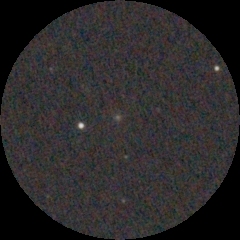
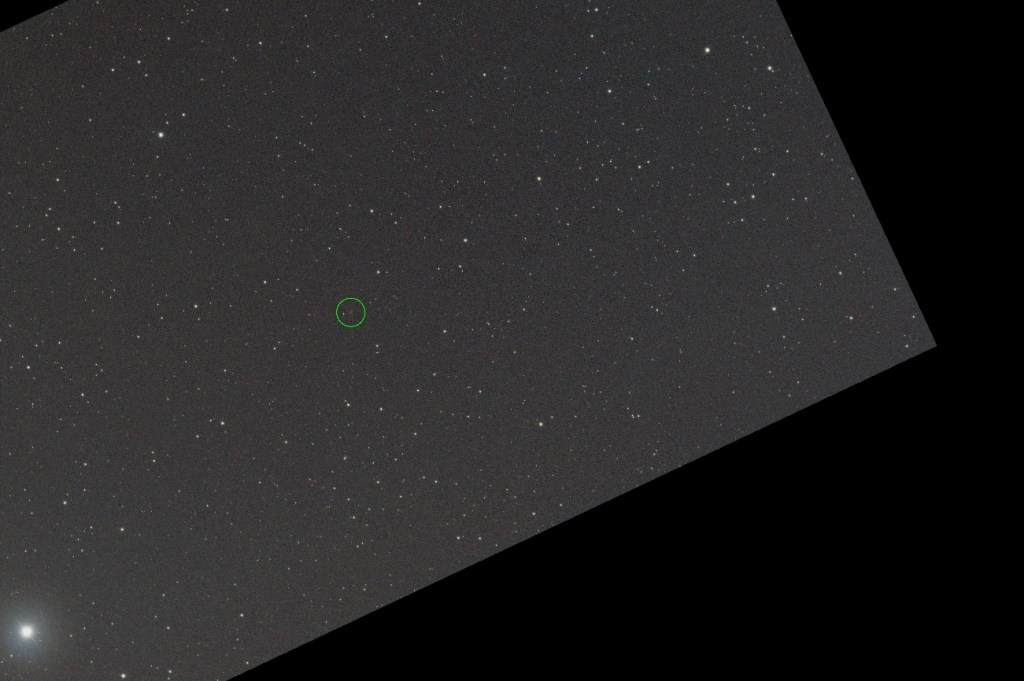
I just think that’s a wonderful name for a galaxy. Unfortunately it’s far away and dim. it’s a stunning 285 million light years away and appears as magnitude 14. Not hard to find but hard to photograph. The near star in the inset is magnitude 12 Gaia DR2 1152635154843863808 (well probably). Polarissima Borealis is NGC 3172.
This is 30 shots of 60 seconds at 800 ISO through the william optics Z61 (360mm f/5).
This is M51 and NGC5195. It’s grainy because it’s only 8 shots. 75 second exposures at ISO 800 through the William Optics z61 so 360mm, f/5.
I’ve cropped it to be similar in size to a shot i did through the takumar lens around this time last year. The Takumar shot (below) is a single exposure because i hadn’t discovered siril yet.
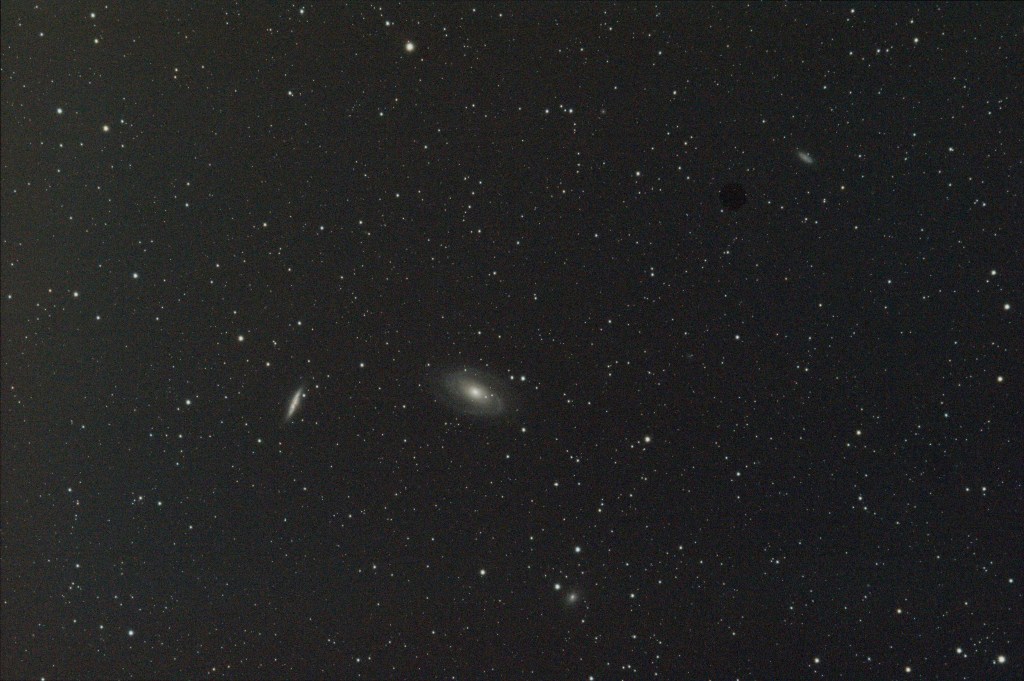
Bode’s is the spiral near the center, to the left is NGC 3034 the Cigar Galaxy. Above to the right is NGC 2976 and below near the triplet is NGC 3077.
This is 45 exposures of 75 seconds each at ISO 800 with my canon t3i and william optics Z61(360/f5). They were stacked and colour calibrated with Siril, autostretched and the black point raised with the asinh processor.
It’s dramatically better than last time i tried this but I still find the images a bit grainy.
Maybe there’s some faint hint of nebulosity there but i can’t see it. This is only nine 45 second lights at ISO 800 through the Z61 so f/5 360mm. I have a streetlight in exactly the wrong spot although i could have done better.
I know my aim is good based on the astrometry output below.
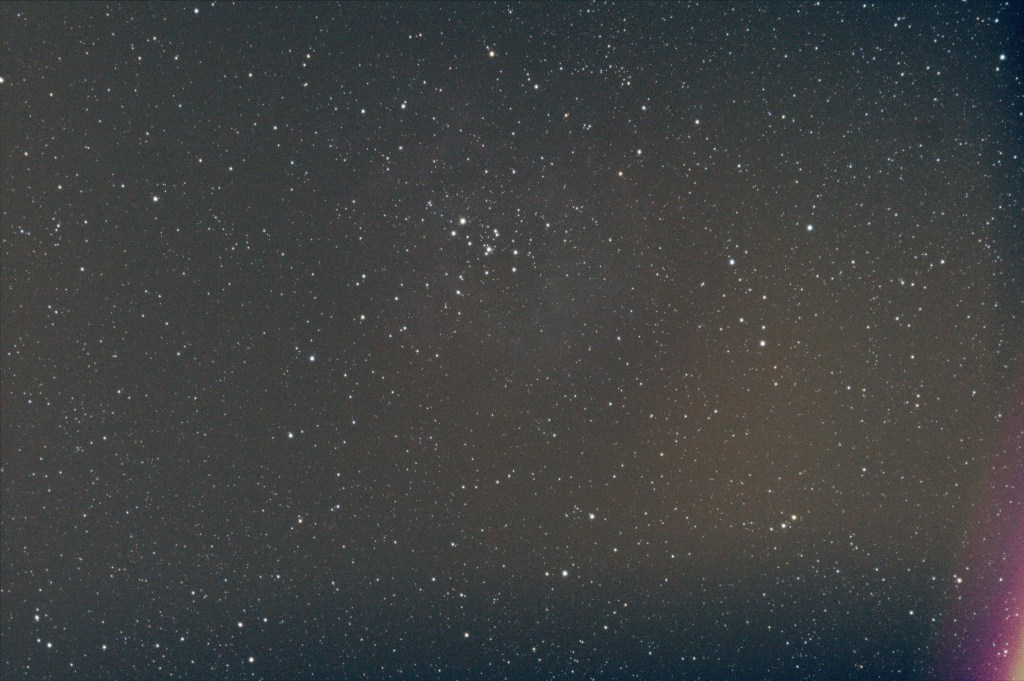
This is the Soul Nebula, IC 1848. A solid hour of exposure in 60 1 minute chunks ISO 800 through the Z61 telescope(360mm f/5) with the Canon t3i. There’s just a suggestion of the nebulosity in the middle. It seems like I would need several hours to get anything much more visible.
Below Andromeda is the smaller Triangulum Galaxy M33. This is 20 exposures of 100 seconds at 800 ISO through the Z61 so 360mm f/5 with calibration frames from other nights. It’s not great but better than my previous effort.
This is fifteen exposures of 60 seconds at ISO 800 with the canon t3i through the Z61(360mm f/5.9) with darks, biases, and flats. You can just see a hint of the nebula with more in red near the top a bit left of centre. I found a better image taken with a similar setup but 120 second at ISO 1600 so much more light. He must have been in a darker spot. I can certainly take more exposures but i don’t think i can up the time or ISO much.
Note to me: I used the Photometric Color Calibration on this which was quick and easy.
Pretty much the perfect target for my setup, the Andromeda Galaxy almost fills the field. This is 30X75 second shots at ISO 800 through the Z61(360mm f/5.9). Postprocessed in Siril. At full view the stars are a bit elongated top to bottom but I’m pretty pleased.
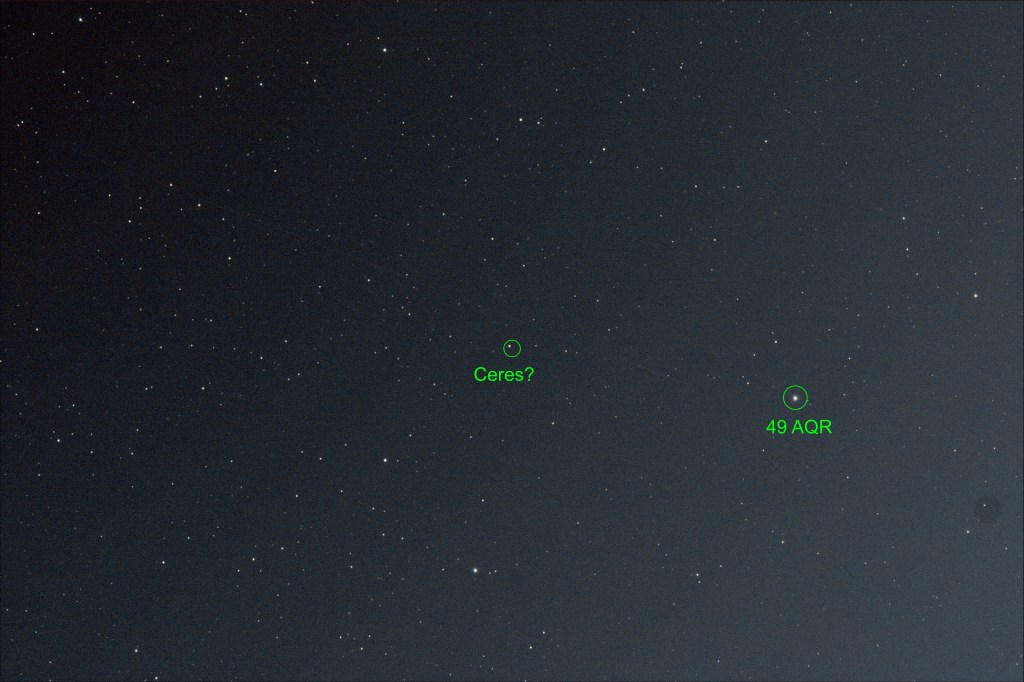
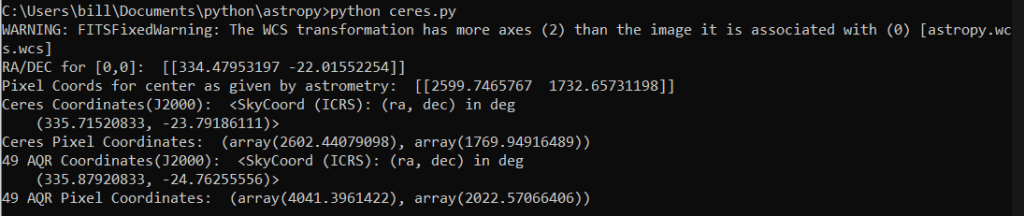
Despite the cold and a bright moon I went out last night asteroid hunting. This is a dozen lights at 30 seconds 800 ISO with the William Optics Z61(360mm f/5.9) with corresponding biases, darks, and flats. I used the same technique as with uranus to locate the pixel where Ceres should be but it was a bit off – 14 pixels X and 12 Y: 18 pixels total which would be 43″ which is an awful lot. But in my defense, there’s nothing else that bright near the correct location and there are plenty of stars dimmer than Ceres(Mag 9) that are showing up perfectly well so probably Ceres plus some error in my calculations or understanding. Interestingly, Ceres would have moved against the background stars over the time I was shooting but only a couple of arc-seconds – maybe 1 pixel. That does mean though that if I had waited an hour or so and shot again I might have had a convincing shift.
from astropy import wcs
from astropy.io.fits import getheader
import numpy as np
from astropy.io import fits
from astropy import units as u
from astropy.coordinates import SkyCoord as SC

hdulist = fits.open(r"c:\users\bill\downloads\wcsceres.fits")
w = wcs.WCS(hdulist[0].header)

pixcrd = np.array([[0, 0]], dtype=np.float64)
world = w.wcs_pix2world(pixcrd, 0)
print("RA/DEC for [0,0]: ",world)

wcrd=np.array([[335.688, -23.789]])
pixcrd2=w.wcs_world2pix(wcrd,0)
print("Pixel Coords for center as given by astrometry: ",pixcrd2)

uc=SC('22h22m51.65s', '-23d47m30.7s')
print("Ceres Coordinates(J2000): ",uc)
print("Ceres Pixel Coordinates: ",uc.to_pixel(w))

uc=SC('22h23m31.01s', '-24d45m45.2s')
print("49 AQR Coordinates(J2000): ",uc)
print("49 AQR Pixel Coordinates: ",uc.to_pixel(w))
EDIT: I went back and picked a single subexposure, ran it through astrometry, and checked the pixel location and ended up with the same error so i dunno.
reEDIT: I googled around and apparently the positions of minor planets in stellarium are easily outdated due to perturbations in their orbits. I’ll check the web version vs the standalone version when i do pluto.
This is not very good although it’s much better than my previous attempt. Twenty lights of 30 seconds at ISO 1600 through the Z61 scope(360mm f/5.9) guided with PHD2. I have had decent results at ISO 1600 but I compared a single sub at 60 seconds ISO 800 and it showed less of the mottling I see in this one. If I try this again I’ll do a solid 30 minutes of 60 second subs at 800.





 Astrophotography Newbie