ASCOM Control!

OK! As of this afternoon I can connect to my mount over a USB cable instead of its wifi which allows me to stay connected to the internet. To do this I’m using the Ascom platform and the POTH hub which is part of it. I can’t use explorestars to command the scope over USB but I can use stellarium which I’m familiar with. Also, I can now have Astrotortilla(not making that up) take a picture through my camera using Backyardeos and check of the mount’s position and send commands to correct it! This will be great if it’s solid. hard to tell on a quiet afternoon in my living room.

Right Ascension and Declination

When the mount/scope is in the home position the Right Ascension axis points at the North Celestial Pole and the Declination axis points toward the Celestial Equator at the Zenith. The Camera/Scope is pointing at the NCP.

Loosening the Dec. clutch lets you sweep around the sky from the north pole to the equator and south pole(which is in the ground).

Loosening the RA clutch lets you sweep up and down the sky from East to Zenith to West.

This is not the right way to think about RA and Dec.

M101 AgainAgain

This is over-processed but I kind of like it. This is 60+ exposures through the Takumar 200mm lens at about f/5.6. Each exposure was 60 seconds at ISO 1600. I had only 3 darks and 9 bias shots and no flats. I used SiriL for the processing following this tutorial. After Siril I used Paintshop Pro 5 to boost the contrast quite a bit further further – (Colors/Brightness/contrast=59 with no added brightness).

This is about 25% of the full image. I don’t care too much about anything outside the central image but i do note really bad vignetting on the full shot as shown below. I’m going to take some flats to see if they help.

I also note that my stars are not great – a little stretching top to bottom. I had what i consider excellent alignment – within two arcminutes. I may not have been perfectly level but i was close.

Claire’s Ring

As part of setting up my camera mount I take a lot of pictures of the area around the north star. There is a cluster of faint stars that look a bit like an engagement ring with Polaris as the diamond. As far as I know the structure has no name so I’ve decided it should be called Claire’s Ring.

This is from a single exposure 1 second ISO 6400 through the 200mm Takumar lens at about f/5.6. I boosted it with Paintshop Pro 5. Stellarium identifies the brighter star in Claire’s Ring as HD 5914 magnitude 6.5 so maybe visible to good eyes under dark skies. The others are all magnitude 8’ish.

Starlink

Starlink 1270 and 1229

This is a faint and janky image of M101. I would normally have tossed it but i noticed two faint scratches running diagonally off to the right of the faint fuzzy. These are two of the Starlink satellites – the first ones i’ve actually seen although heavens above is full of them. The image was taken through the takumar 200mm lens at f/5.6 120 seconds at ISO 800.

Repeating Galaxy Hunting M101

This is not awful at all! Nine out of 14 exposures 90 seconds, ISO 800, f/5.6 with the Takumar 200mm lens on the canon t3i. The spiral of the pinwheel nebula is faint but clear. and you can see the faint fuzzy of NGC 5474 below and to the right. In fact, aided by Astrometry.net and the eye of faith I can see at least NGC 5473 below M101 and left, NGC 5485 still lower and left and NGC 5422 above and left of M101.

I used DeepSky Stacker per this tutorial which is clear and specific. I had taken more images earlier in the month and stacked them then with less success.

M13

From my back yard I have good views to the high north, east, and overhead. M13 – the great cluster in Hercules was ideally positioned last night with no moon but the seeing was fairly crappy. I was really just out to try sharpcap polar alignment but i took a couple of quick snaps.

This is one shot to JPG 60 seconds ISO 400 about f/5.6 through the Takumar 200mm lens. I’m pretty pleased.

Sharpcap Pro – Best $17.20 I’ve Spent Lately

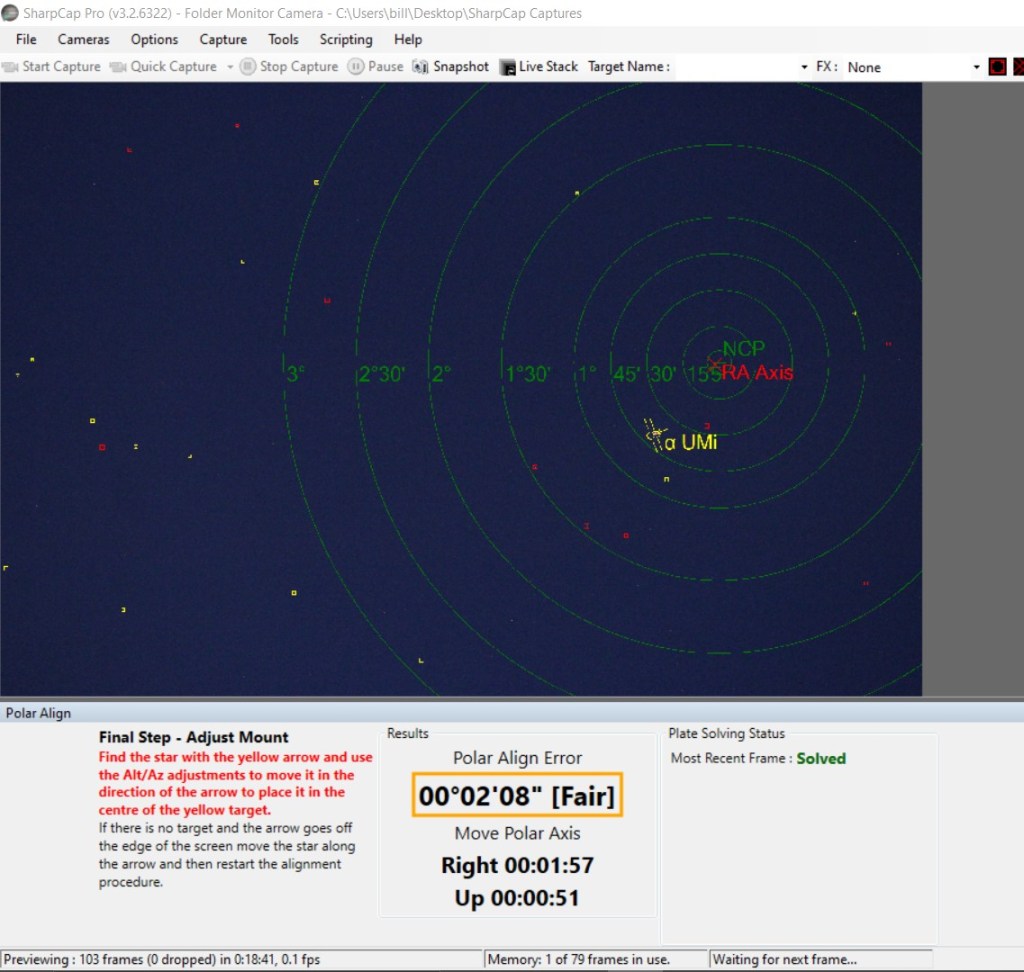
I bought a copy of Sharpcap Pro which has a variety of astrophotography uses including polar alignment. I tried it last night with excellent results. The process is a bit similar to Photopolaralign but it’s fully automated. You take a pair of pictures rotating the mount 90 degrees around the polar axis between them and it tells you how far and in what direction to move the mount to correct your aim. You make the adjustment then keep taking pictures while it watches until you get as close as you care to. The image below is a bit hard to follow but it’s telling me that i’m within a couple of arcminutes of correct which is excellent. Sharpcap is doing the same plate solving that my earlier process was doing but it has its own built in indexes and it solves in milliseconds rather than 10-20 sec. Sharpcap would control many kinds of cameras directly but not my DSLR so I had BackyardEOS continually taking pictures while Sharpcap monitored the folder looking at the latest. Despite my newbie fumbling i was done in 10 minutes after it got dark.

Geez – I’ll Take This! – M81 and M82 Processed With DeepSkyStacker

M81 and M82 Stacked and Processed with DSS

Wow – I’m pleased with this. That’s 10 images taken with the Takumar 200mm lens at f/5.6 on the Canon t3i 60 seconds ISO 800 with three darks and one bias. They were stacked in DSS and postprocessed there as well following this tutorial. It’s cropped to about 1/4 of the original. The focus wasn’t perfect, there’s still some Chromatic Aberration, and I’ve probably over-processed it but it’s fine.

Above and to the left of M81 you can see a corner of three stars and, just beyond, a fuzzy patch that is probably NGC3077. M81, M82, and NGC3077 are all about 12 million light years away.