Triangulum-ation

19-12-04 astrometry M33

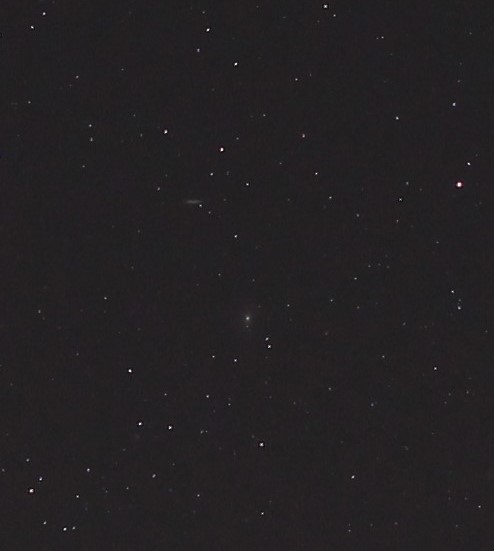
Conditions were perfect the other night for imaging the Triangulum Galaxy, M33 from my back yard.  I could see Polaris over my neighbours’ houses and the constellation was almost overhead.   I had my usual sh*t show setting up and the only thing i ended up with was the last of my setup shots: 20 seconds at f/5.6 ISO 1600 with my 18-55mm lens fully zoomed.  I shot a full session with the 50mm lens after that but the focus was out.  Anyway, Astrometry confirmed that I was pointed to the right part of the sky.  which is between Triangulum and Mirach in Andromeda. In the image above from astrometry I added the “M33” text to show where it should be.

19-12-04 green_4359

Looking real hard at the area the eye of faith says there’s a smudge but really nothing to be sure of. M33 is just a bit dimmer than M110 which shows up as a puff in shots taken with my 50mm lens 60 seconds f/3.5 ISO 800.  So I was more or less exposing the same but for only 1/3 of the time.

So, for next time: check that the battery is in the camera(!); make sure the headlamp works; remember to pre-focus the 50mm lens and tape it; check that all the screws are tight on the mount and tripod; and try for 60 seconds, f/3.5 ISO 800 with the 50mm lens.

UPDATE: processing the image a bit more subtly with something called Rawtherapee I’m morally sure there’s a faint puff at the right spot so next clear night should do it. I can still see it in the cropped shot below but mostly because of the star patterns around it.
19-12-06 IMG_4359_rawtherapee

Home Made “Y” Mask


img_5652-1I’ve heard of Bahtinov focusing masks masks but now the cool kids are using Y shaped masks. From what I can see the dimensions and even the angles are not critical. Somehow the shape causes a diffraction pattern that has a specific shape when the camera is well focused(see below where the three spikes meet). I’m hoping to try it tonight if the sky is clear enough.


post-13139-133877463084

iPhone Andromeda

A bit surprisingly my phone can capture some of the brighter stars. On the left is most of Cassiopeia then the cradle shape of Andromeda and the two stars off to the right are in Ares. The ones that show up are around mag 2.0 but you can just see one of the mag 3 stars in Triangulum between Andromeda and Ares.

The phone is an iPhone XR and the picture was tweaked every way I could to bring up the stars and blacken the background.

This Bode’s Well – In Which I Am Even More Galactic

Above Dubhe (the lip of the big dipper) there are two relatively bright galaxies Bode’s Galaxy M81 and the Cigar Galaxy M82.   I was hoping I could catch them because they are the same sort of size and brightness as M110 which showed up near the Andromeda Galaxy with the same lens.

19-11-21 Bodes-Cigar 4311

This is a single 60 second exposure with the 50mm Canon lens at f/4 and ISO 400.  It has been cropped very significantly and poked at with the windows photo tool.  In the field I thought this was too blown out so i took 10 30 second exposures and tried stacking them with deep sky stacker but i just wasn’t getting enough light.

The image below is the unmolested original. Obviously I need a longer lens.  This is all good fun though.  I was pleased that I was able to locate the galaxies by keying off Dubhe and learning to recognize little asterisms like the triplet near the middle of the original below.
IMG_4311

The Cradle of Andromeda

19-11-09 Cradle-2 4191

This unimpressive goody is the only legacy of a cold hour with a new lens. I like this part of the sky with Cassiopeia and Andromeda.  I was hoping to get the stars against a bit of blue background but this is the best i could do in post processing.  The original was done 4 seconds 18mm f/4 ISO 1600.  I boosted the colour a lot and brightened it with the windows photo tool.

The lens is a used Sigma DC 18-200mm f/3.5-6.3 on a Canon t3i.  It’s not my favourite lens: the glass itself may be ok but the zoom is stiff and yet it will collapse the zoom if it’s left pointed up.  There is a zoom lock but that’s stiff and hard to find.  It’s easy to knock it off focus and the focus changes as you zoom.

My worst problem last night was the cold though.  I’m used to working a lot by feel in the dark and numb fingers are not much help that way.

Meanwhile Back in Nikonia

I was out one night earlier in the month trying to image M31 with the Nikon P900.  The results were pretty dismal.  Below are my three best tries.  The first one is from a starscape video so 25 sec ISO 100 and the others are ISO 6400 1/2 sec.  In each case you can see the Andromeda Nebula as a smudge.  The smudge is pretty blocky in the video frame.   I looked at a number of the frames and they were similarly blocky so i doubt that stacking would make a difference.  So the Nikon makes night sky photography easy and fun but not that rewarding – the sensor is just too small.

DSCN2006_Moment (3)DSCN2035 (2)DSCN2034 (2)

Adrom-Encore

19-10-29 M31 135mm 4106 (2)

I was out again last night with my 135mm lens but without a dew heater so I got better resolution on M31 but not as sharp as it could be.  This is a combination of 8 not-too-smeary shots at with the canon t3i at 135mm f/5.6 75 seconds ISO 1600. I stacked and stretched it with pixinsight following Alan Hall’s book then decoloured and dimmed it with the windows photo tool.

The image below is 8 shots at ISO 3200, 37 seconds, 135mm.  I did this hoping the lens would get less smeary between wipes.  I haven’t decoloured it and the crop is a bit different but, if anything the longer subs are better.


M31 135mm iso3200 4116

Androm-again – And Is She Stacked!

19-10-24 stacked M31-cropped

I am pretty pleased with this result.  Eleven images 60 seconds each at f/3.5 ISO 800 shot at 50mm and cropped.  Processed with pixinsight using guidance from Alan Hall’s book. After stacking with pixinsight The image had a greenish tint and I eliminated that by using the color slider in the windows photo tool, then used the brightness slider to reduce brightness a bit.  That’s a crude tool but i’m happy with the result.

Above M31 you can see M110 and the greyer “star” below it is M32.  The two brighter stars  midframe are v Andromeda and 32 Andromeda.  Near the bottom center us u Andromeda.

Below, for reference is IMG_3963, one of the 11 frames stacked to generate the picture in its original size and roughly cropped to match the above.

I now have a 135mm lens which I intend to try on the next good evening.  Assuming I can do 60 second exposures I would need higher ISO to get the same brightness because the lens is f/5.6 rather than the 3.5 I was using for the above.  According to this I think the brightness ratio is (5.6/3.5)^2 or about 2.5 so I will try ISO 1600 for 75 sec and if that’s no good, ISO 3200 for 37 sec.