This is fifteen exposures of 60 seconds at ISO 800 with the canon t3i through the Z61(360mm f/5.9) with darks, biases, and flats. You can just see a hint of the nebula with more in red near the top a bit left of centre. I found a better image taken with a similar setup but 120 second at ISO 1600 so much more light. He must have been in a darker spot. I can certainly take more exposures but i don’t think i can up the time or ISO much.
Note to me: I used the Photometric Color Calibration on this which was quick and easy.
Siril is very easy to use for processing astro-images. One think I’m never sure about is the colour calibration step that requires me to pick white and black sections of the image. It turns out that Siril has a built-in function that can look at what section of the sky you’ve photographed and correct your colours. I tried it on my image of M31 from the other night and it’s a bit tricky to start up but it did seem to work well. The image below is per Siril PCC plus a little bit of raising the black point with the asinh function. I feel like it’s a bit greeny compared to my best effort. Bumping the saturation up just made it worse – I actually prefer my previous version right below it.
I’m looking forward to trying this on the ring and dumbbell nebulae though, next clear night.
Pretty much the perfect target for my setup, the Andromeda Galaxy almost fills the field. This is 30X75 second shots at ISO 800 through the Z61(360mm f/5.9). Postprocessed in Siril. At full view the stars are a bit elongated top to bottom but I’m pretty pleased.
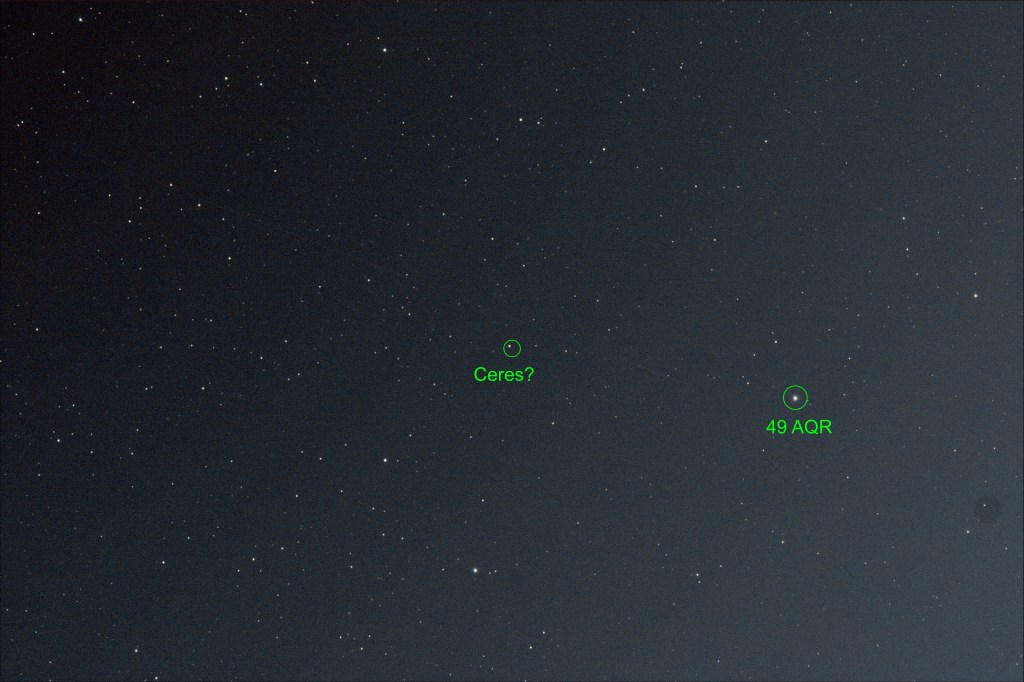
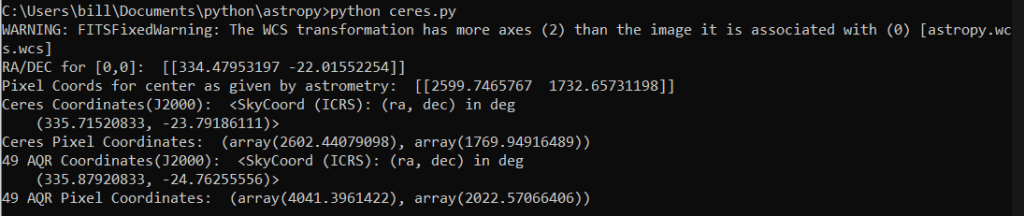
Despite the cold and a bright moon I went out last night asteroid hunting. This is a dozen lights at 30 seconds 800 ISO with the William Optics Z61(360mm f/5.9) with corresponding biases, darks, and flats. I used the same technique as with uranus to locate the pixel where Ceres should be but it was a bit off – 14 pixels X and 12 Y: 18 pixels total which would be 43″ which is an awful lot. But in my defense, there’s nothing else that bright near the correct location and there are plenty of stars dimmer than Ceres(Mag 9) that are showing up perfectly well so probably Ceres plus some error in my calculations or understanding. Interestingly, Ceres would have moved against the background stars over the time I was shooting but only a couple of arc-seconds – maybe 1 pixel. That does mean though that if I had waited an hour or so and shot again I might have had a convincing shift.
from astropy import wcs
from astropy.io.fits import getheader
import numpy as np
from astropy.io import fits
from astropy import units as u
from astropy.coordinates import SkyCoord as SC

hdulist = fits.open(r"c:\users\bill\downloads\wcsceres.fits")
w = wcs.WCS(hdulist[0].header)

pixcrd = np.array([[0, 0]], dtype=np.float64)
world = w.wcs_pix2world(pixcrd, 0)
print("RA/DEC for [0,0]: ",world)

wcrd=np.array([[335.688, -23.789]])
pixcrd2=w.wcs_world2pix(wcrd,0)
print("Pixel Coords for center as given by astrometry: ",pixcrd2)

uc=SC('22h22m51.65s', '-23d47m30.7s')
print("Ceres Coordinates(J2000): ",uc)
print("Ceres Pixel Coordinates: ",uc.to_pixel(w))

uc=SC('22h23m31.01s', '-24d45m45.2s')
print("49 AQR Coordinates(J2000): ",uc)
print("49 AQR Pixel Coordinates: ",uc.to_pixel(w))
EDIT: I went back and picked a single subexposure, ran it through astrometry, and checked the pixel location and ended up with the same error so i dunno.
reEDIT: I googled around and apparently the positions of minor planets in stellarium are easily outdated due to perturbations in their orbits. I’ll check the web version vs the standalone version when i do pluto.
This is not very good although it’s much better than my previous attempt. Twenty lights of 30 seconds at ISO 1600 through the Z61 scope(360mm f/5.9) guided with PHD2. I have had decent results at ISO 1600 but I compared a single sub at 60 seconds ISO 800 and it showed less of the mottling I see in this one. If I try this again I’ll do a solid 30 minutes of 60 second subs at 800.
This is pretty sweet. About 15 subs 45 seconds at ISO 1600 with a canon t3i through my new-to-me William Optics Z61 refractor (360mm f/5.9). Processed in Siril with darks, biases, and flats. Guided by PHD2 with a QHY5LII-M camera and a qhy mini guidescope.
I still need to do some balancing adjustments to the setup but the guide scope is solidly mounted to the Z61 and the camera is secure. You can see that the counterweights are pretty much to the end of the shaft so this is about as much weight as i’d be comfortable putting on the mount. As it is the scope and camera are enough of an armful for me to carry when i’m setting up. I could pick up the whole thing but it would be awkward.
Stack of 10 images 800 iso 45 seconds 200mm f/4 cropped to about 1/3
The image is not inspiring and, at magnitude 5.7 Uranus is not a tough target but i’m pleased for a number of reasons:
It’s Uranus for pete’s sake, 3 billion kilometers away
I found it in the image by using the WCS file that astrometry.net produces
I learned about relating my images to stellarium’s displays
There are a bunch of faint stars that i can get my eye in on
I routinely do image recognition by uploading to astrometry.net. Besides the annotated image as below, it provides a WCS.fits file that provides the info you need to map from astronomical coordinates (RA and Dec) to pixel locations in the image. The python script below reads the WCS file and uses astropy to determine the pixel location for uranus.
from astropy import wcs
from astropy.io.fits import getheader
import numpy as np
from astropy.io import fits
from astropy import units as u
from astropy.coordinates import SkyCoord as SC

hdulist = fits.open(r"c:\users\bill\downloads\wcsuranus.fits")
w = wcs.WCS(hdulist[0].header)

pixcrd = np.array([[0, 0]], dtype=np.float64)
world = w.wcs_pix2world(pixcrd, 0)
print("RA/DEC for [0,0]: ",world)

wcrd=np.array([[36.542, 14.101]])
pixcrd2=w.wcs_world2pix(wcrd,0)
print("Pixel Coords for center as given by astrometry: ",pixcrd2)

uc=SC('2h27m45.84s', '14d6m14.0s')
print("Uranus's Coordinates(J2000): ",uc)
print("Uranus's Pixel Coordinates: ",uc.to_pixel(w))
I finally realize that i can line up my images with the stellarium displays if i put stellarium into equatorial mount mode and rotate it’s image right 90 degrees. I still find this a bit confusing but the equatorial mode is key.
Oh, also, I think the faintest stars I can reliably pick out are around magnitude 11-12 so i’m a long way from pluto’s 15.
Nope, not even close. The bottom left is 98 Psc mag 4.8, 49′ from mars, the top right is 95 Psc mag 7.5, 17′ from mars. Demios is mag 12, 1’13” from the center of mars. Phobos is mag 10.6, 23″ from Mars. Mars itself is about 21″ across which would be 5 pixels at the scale of this image – the blown out central body above is 60 px, about 4′, totally obliterating the moons. The image is 30 sec ISO 800 through the Takumar 200mm lens wide open at f/4.
I went out on a different last night to try a bunch of exposures. As it happens, the shortest I tried was 1/1000 of a second at ISO 800 through the 200mm Takumar at f/4. At that exposure the body of mars is visibly round at about 6 pixels but it would be hopeless to think about seeing the mag 11 and 12 moons. Nevertheless there is a faint smudge in the correct spot of one of them to be the inner moon. I give you FauxBos… This is a 4X blowup.
Mars with FauxBos
Back in reality-land I measured the size of overexposed Mars in a bunch of exposures at ISO 800. It scales fairly smoothly . At 1/500 sec Mars is 15PX, at 1/60 sec it’s 30PX. Phobos was about 30″ or 7px from the center of mars, deimos about 1’17” or 16px. So somewhere below 1/60 sec Deimos would not be swallowed but would probably too dim to see.
I may try this again when I have my new telescope although the fundamental problem remains. This article is not as discouraging as some i’ve seen. This cloudy nights post actually has amateur photographs of the moons although done with much better equipment than i am using.
I’m delighted with this image of M57, the ring nebula in Lyra. I wasn’t sure I could see it at all, it’s very small compared to the galaxy targets I’ve been shooting. The ring is only about 15 pixels across in the final image but it seems perfectly clear to me. This is 11 lights at 25 sec ISO 800 shot through the Takumar 200mm lens wide open at f/4 combined with darks and biases, no flats. Processed in Siril then cropped to about 1/10 of the original. After Siril I used Paint Shop Pro and reduced brightness -15 and boosted contrast +26.
Wikipedia gives the dimensions as 230″X230″ (arcseconds) so about 4’X4′ (arcminutes) I think my camera/lens is supposed to be 2.2 arcsec/pixel so that would be only 10 px where my image is about 15px. Maybe bad focus or CA fuzziness are helping me out for a change! Jupiter at opposition is only about 50″.
UPDATE: My images are about 4.4 arcsec/pixel so 15px is 66 arcsec. NASA gives the size as 1.3 arcmin so i’m missing the red part – that’s fine.
The actual object M57 is about 2500 light years away and almost a light year across. which is around the 1.3 arcmin NASA gives.
For processing I am trying to centralize my calibration images – darks, biases, flats – and use symlinks to make Siril think they’re in the directory with the lights.
Table 1 on this page gives specific magnitudes for lenses at 30 second exposures. It shows a 50mm f/1.8 lens yielding mag 13 and a 200mm f/2.8 yielding mag 15.2. He gives an intermediate calculation of a “Clark Exposure Factor” of pi/4*aperture-in-cm^2*exposure-time-in-minutes. If I apply them I get a figure of magnitude 14.5 for my 200mm f/4 camera lens and 15.5 for my on order Z61 telescope. Also, woohoo, I just pasted an image into my wordpress blog – that’s a big advance!
So if i’m right a several minute exposure with my 200mm lens should be easily able to show Pluto.
Unfortunately, tonight is about the last night before the moon casts its blight on the landscape and it’s not supposed to be great.
This post from reddit says they imaged pluto with a DSLR and an Orion ST80. I think the Scope is 400mm f/5 and he was shooting 60 second subs but doesn’t mention the ISO.




 Astrophotography Newbie